patrick@fribourg:~$ man loookloft
Loookloft
A sonar for your home. Your place is full of devices talking Bluetooth: the speakers, the watch, the TV, the keyboard, the light bulbs. Loookloft listens to them. On a closed iPhone Duo, it is a submarine sonar: every device becomes an echo, and every echo sings its own note. Open the Duo and you surface, to find out what the dive brought back: the list of devices, their inventory, a plan of your home.
status: beta, tested through TestFlight a side project, next to staygroov made for: iPhone Duo (also runs on a regular iPhone and on iPad) not on the App Store yet no account, no server of mine, no tracking
loookloft --dive
- Closed, you dive. On the Duo's outer screen, the sonar fills the display: a wave leaves the centre every two and a half seconds, and the Bluetooth devices around you light up as echoes when it reaches them.
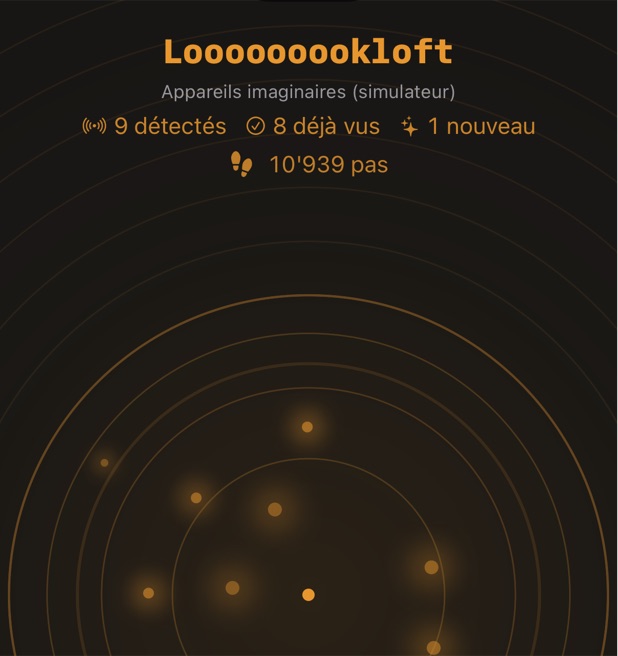
- The stronger the signal, the closer the echo to the centre. The rings mark a strong, medium, weak and very weak signal. The name stretches when a device is very close: Loookloft, Looooookloft, Loooooooookloft.
- Music generated from what the app discovers. Every echo sings its note when the wave reaches it, always the same for the same device, in a shared scale: ten devices make a little tune, not a racket. The kind of device picks the instrument, the signal strength the volume. The rhythm comes from the devices themselves: those that advertise quickly repeat their note, the beat speeds up as the crowd grows, and a moving signal makes the loop swing. Nothing is prerecorded, and every dive draws its own scale, instruments and room at random: no two dives sound alike.
- A button to mute the sound, next to “Surface”, remembered from one launch to the next. The music mixes with yours and keeps playing with the screen locked; this button, and only this button, silences it.
- Your steps are counted during the dive, with your heading and altitude: that is what draws the plan.
- Open, you surface: the sonar goes quiet, and the logbook opens on what the dive brought back.
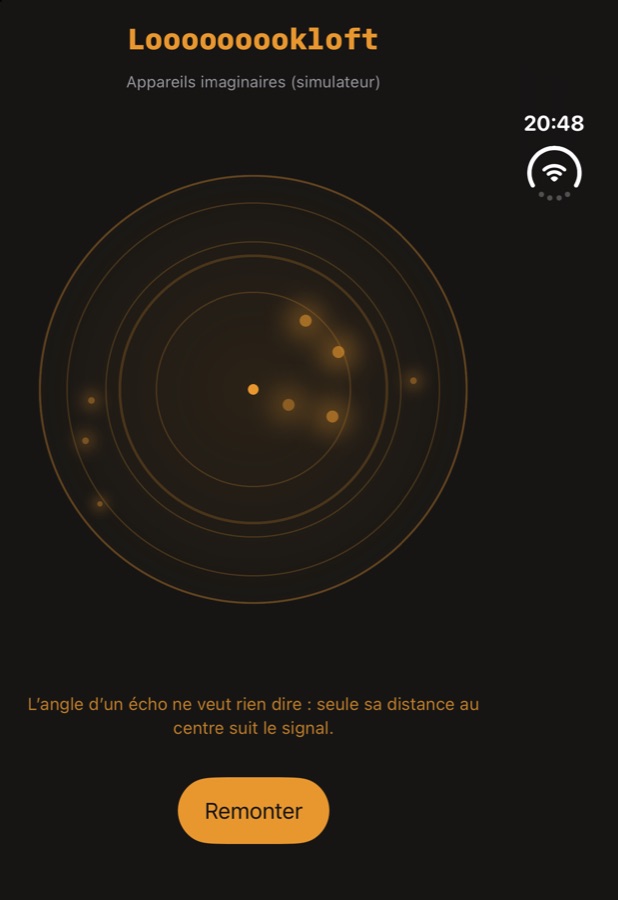
- Three counters at the top of the sonar: the devices detected since the dive began, those the logbook already knows, and the new ones. Apple's identifiers, which change every few minutes, don't count.
- With Siri: “Dive with Loookloft” opens the app and starts the dive.
loookloft --music
During the dive, Loookloft composes its music live, from what it discovers. Nothing is prerecorded: the app synthesises everything.
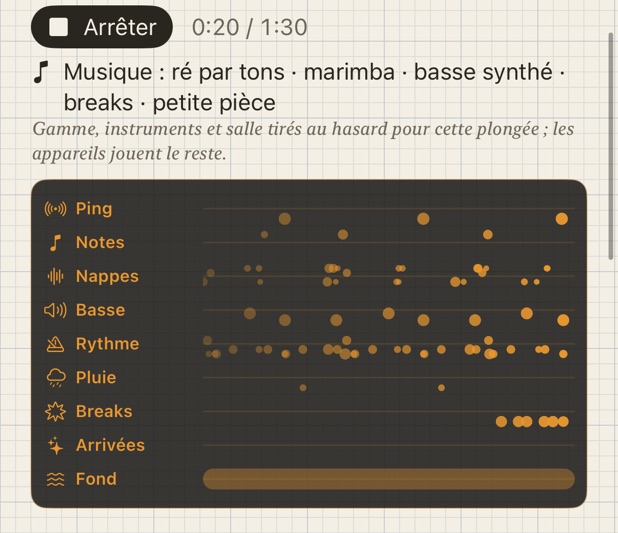
- Every dive has its own music. At the start, the app draws a scale and a key, an instrument for each family of sounds (bell, marimba, glass, plucked string, organ, strings…), a room, and a synthesiser whose settings are drawn at random too: waveform, voices, filter, envelope.
- The devices play the rest. Each has its note and the instrument of its kind; its signal strength sets its volume. How fast it advertises, the crowd around and movement make the rhythm and the tempo.
- Breaks at the end of each phrase: snare roll, toms, reversed cymbal, hand claps, then a cymbal.
- One dive in three, motifs in canon, in the manner of Terry Riley's “In C”: a pulse, and each device moves through its motifs at its own pace. The manner, not the notes: the motifs are invented for each dive.
- Nine tracks, under the sonar. Ping, notes, pads, bass, rhythm, rain, breaks, arrivals, background: you see the notes scroll by, and turn a track off or on with one tap while the music plays.
- “Another music” if you don't like this one: another palette, right away.
- It keeps playing with the screen locked, mixed with your music, and the dive shows on the Lock Screen.
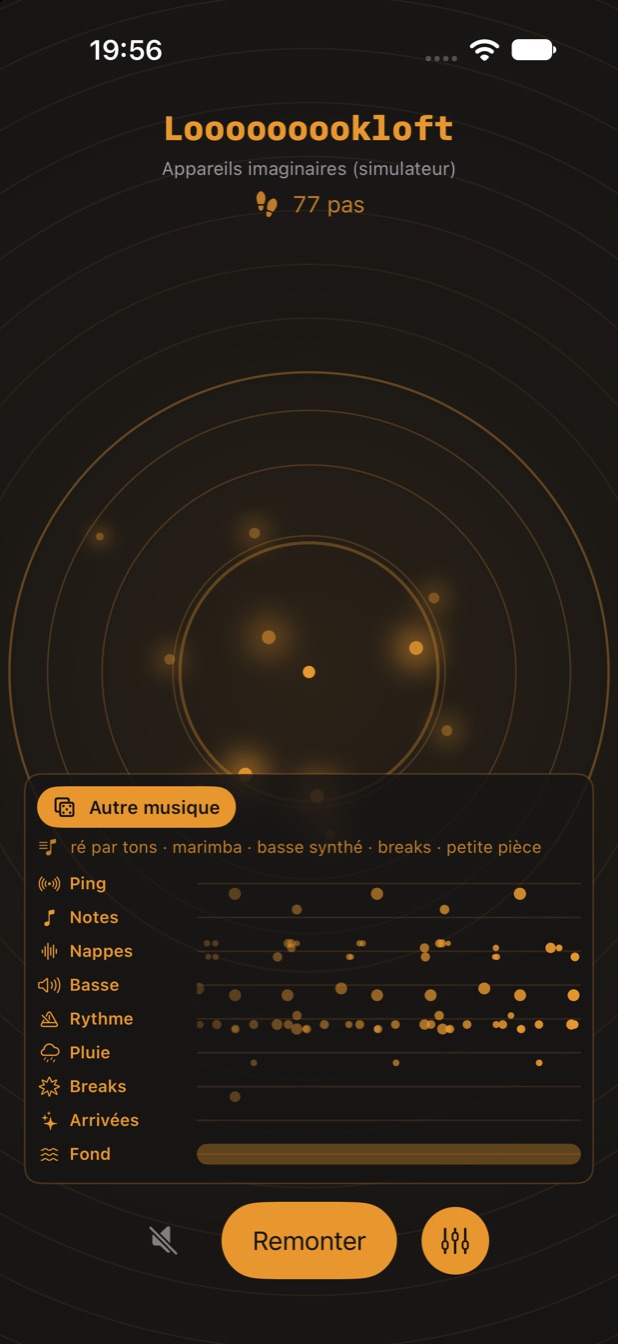
- Replaying a dive plays exactly its music again: its palette is kept with it. The tracks scroll by as under the sonar, and can be turned off the same way.
loookloft --surface
Open, the Duo becomes a dive logbook: cream paper, ink, a fine grid.
- The total at the top of the report, then the inventory by product and brand: “1 Sonos speaker · 1 Samsung TV · 1 Philips Hue light · 1 iRobot robot”. Tap a line to see its devices, and the plan highlights only them.
- Mine, not mine, not sure. Every device is sorted with one tap and takes its colour: green for yours, slate for what isn't, orange for what is still to identify. The list reads in groups, then by kind, from strongest to faintest. An Identified page gathers everything you've said.
- Passers-by set aside: a device heard very faintly for less than a minute is probably passing through. It goes into a folded line and stays out of the way.
- Your own name for a device that announces none (“Kitchen thermometer”), and “already heard in 12 dives” on every line.
- Replay a dive's soundtrack, or a single device to check its signal. Or search for it live: the iPhone listens to it alone, with its current signal and its curve, while you walk.
- The brand as a stamp, when the device says it itself: its manufacturer ID, its model name (Marshall Acton, Sony WH-1000XM, Bose QuietComfort…), or the beacon Microsoft publishes.
- Apple Intelligence, on the iPhone only: a name idea for a loft, a question for the next dive, the story of a bus ride.
loookloft --lofts
One loft per place: home, office, the bus stop. Each has its own logbook and its own plan.
- The loft plan, assembled from all your dives: every footstep you took, a thin line around them, and each device placed where you heard it best. Yours close to your steps, the ones still to identify up to the line, the ones that aren't at your place outside it.
- Full screen, you zoom and pan: the badges spread out, each with the icon of its kind and its name. Next to it, the numbered legend, where you can still say “mine” or “not mine”.
- Lofts without going through a dive, and dives filed with one gesture: a long press in the logbook, several at once, or “Add dives” from the loft's page.
- GPS tells them apart, even when your earbuds and watch follow you everywhere. A bus ride becomes “Journey no. 3”, with its route on Apple Maps.
loookloft --at-home
Two helpers, only when you ask, to recognise your own devices. Nothing leaves the iPhone, except to your own iCloud if you switch sync on.
- My Wi-Fi. For a few seconds, the iPhone listens to what the devices on your network announce themselves (AirPlay, Sonos, Chromecast…). A sonar device with the same name is suggested as “mine”. The Wi-Fi also gives their model: an AirPlay speaker that only gave its brand is no longer unknown, and a Sonos speaker announcing itself with a bare code gets its room name back.
- My Home. With your permission, the app reads your home in the Home app (accessories, rooms, zones), without ever controlling anything. A device with exactly the name of an accessory becomes “mine”, with the room you gave it.
- Lights are never taken for passers-by: a Hue bulb announces itself rarely and faintly, but it doesn't wander off.
loookloft --my-things
Everything you marked “mine”, shelved like a library.
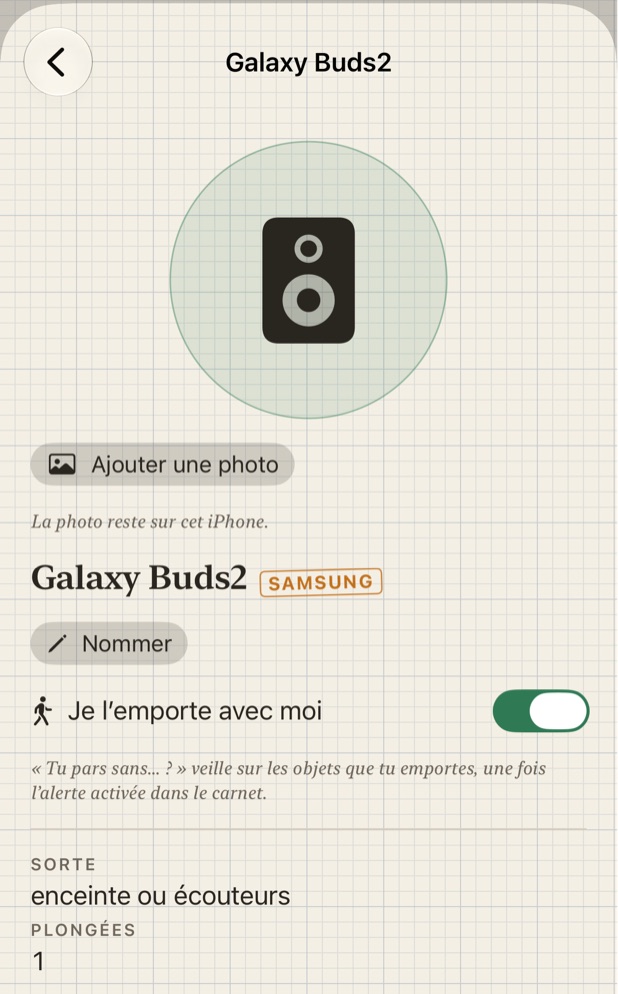
- A card for each object, with a drawing that looks like the real thing: a speaker, a TV, earbuds, a robot vacuum. Or your own photo, which stays on the iPhone. Never a picture taken from a manufacturer.
- Where you last heard it: the address of where you were (“3 Market Street, Fribourg”), and whether it's always the same place. Where you were, never where it is.
- The inventory to take away, as a PDF and a spreadsheet, for insurance, a move, or just to take stock. It only leaves through the share menu.
- Lists you can sort by time, kind, maker, signal or name, and by “most often seen”, including what isn't yours. Crossed devices can also be read by place or on journeys.
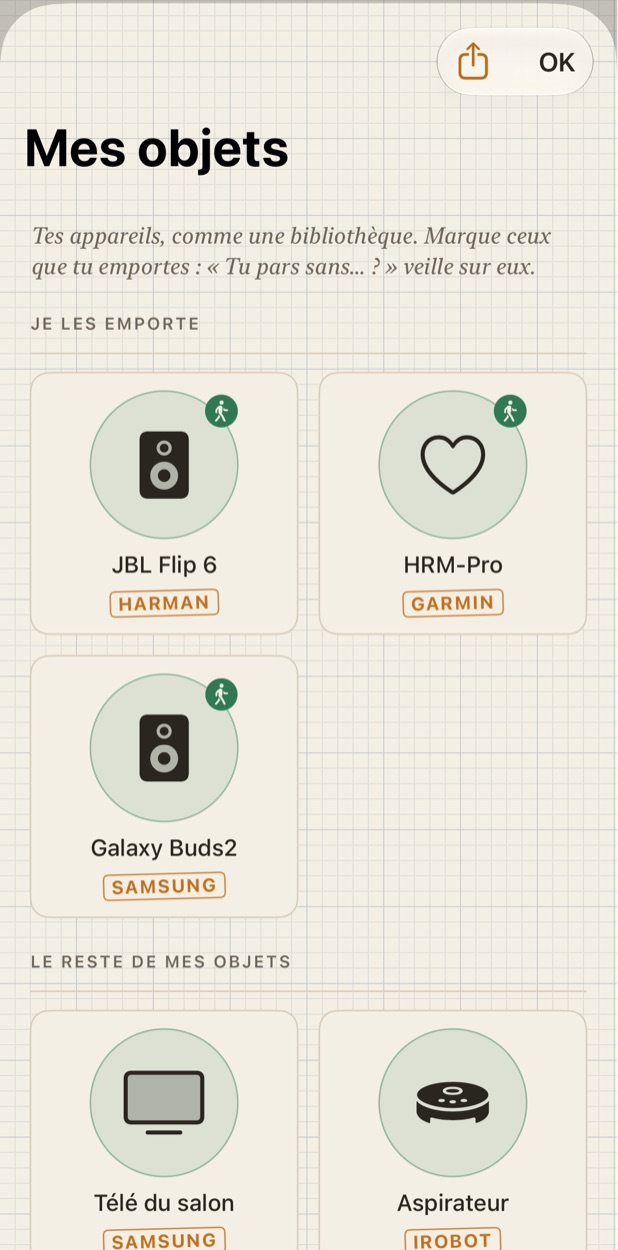
Three alerts, to switch on in the logbook. They're worked out on the iPhone, as local notifications.
- “Leaving without…?” During a dive, an object marked “I take it with me” that hasn't been heard for two minutes, while you've walked at least a hundred steps. “No longer heard”, never “forgotten”: it may be switched off, or muffled at the bottom of a pocket. In the background, iOS doesn't let Apple devices be heard.
- “A tracker coming along?” A tracker that isn't yours (Tile, Chipolo, Samsung…), heard at three different places on the same day. Perhaps a colleague on the same bus: the app says what it heard, never “someone is following you”. AirTags change their identifier; iOS already watches over them.
- The week's summary, on Sunday evening: the devices you crossed, newcomers in your lofts, your longest dive.
loookloft --everywhere
Your logbook on your other devices, and the app without opening it.
- iCloud, if you want it. Sync is off by default. Switched on in the logbook, it puts your whole dives (devices heard, steps, soundtrack, palette), your lofts and your marks in the private database of your iCloud: on the iPad, you replay a dive from the iPhone and look at a loft's plan. The GPS track has its own switch, off as well. I never have access to this data.
- What stays on each device: crossed devices (iOS gives the same device a different identifier on each iPhone), what the Home app says, the photos of your objects, the settings.
- An iPad version, where the logbook, the plans and replays take up the whole screen.
- A widget: your last dive and its devices, on the Home Screen. And “Last dive in Loookloft” to ask Siri.
- A dive's music as an audio file (AAC, three minutes at most), to share like a track.
loookloft --honest
An iPhone hears one thing only: the strength of a signal. It is an estimate, not a measurement. Apps that promise more are making it up.
- No distance in metres, no score out of 100: a strong, medium or weak signal, and its value in dBm, that's all.
- No direction. The angle of an echo on the sonar means nothing, and the screen says so. The sound doesn't pan from one ear to the other for the same reason.
- No owner. iOS gives each device an identifier specific to your iPhone, never its real address. Apple's iPhones, watches and earbuds even change identifier every few minutes. You say what is yours; the app doesn't guess.
- No guessed floor or room. Bluetooth says neither “upstairs” nor “across the street”. The only room shown is the one you gave yourself in the Home app.
- No guessed brand. The stamp repeats what the device announces, nothing more. Medical sensors stay “health or sports sensor”, with no brand: nobody needs to know that a neighbour wears a glucose sensor.
- No connection to devices. Loookloft listens to what they announce, without ever talking to them.
cat ~/loookloft/roadmap
The sonar and its music
Diving with the Duo closed, the wave, the echoes, and music generated from what the app discovers: one note per device, rhythm and tempo from their advertising, the crowd and movement. It keeps playing in the background; the sound mutes with one button.
The logbook and the inventory
One page per dive: the total, the inventory by product, the grouped list, mine or not mine, passers-by set aside, the replay.
Lofts and their plan
Each place has its logbook and its plan, with all your footsteps, full screen and zoomable. Each device sits where you heard it best, never where it actually is.
My Wi-Fi and My Home
Your devices recognised by their name on your Wi-Fi and in the Home app: speakers, TVs, lamps, and their room.
My things and alerts
A library of your objects, where you last heard them, the inventory as a PDF, “Leaving without…?”, the tracker coming along and the week's summary.
iCloud, iPad, Siri
The logbook in your private iCloud, if you want it, the iPad, a widget, Siri and a dive's music as an audio file.
The beta
A version to try on a real iPhone, through TestFlight, internal testing for now.
Apple Watch
A second ear on the wrist, and a round screen made for a sonar.
What happens at home stays at home
Signals, the logbook, lofts, your journeys, your Wi-Fi and your home stay on the iPhone. If you switch iCloud on, the logbook goes to your private iCloud database, which I can't read. The map and addresses go through Apple Maps.
An idea, a question? The easiest way is to write to me on Mastodon.